on shooting myself + creative play
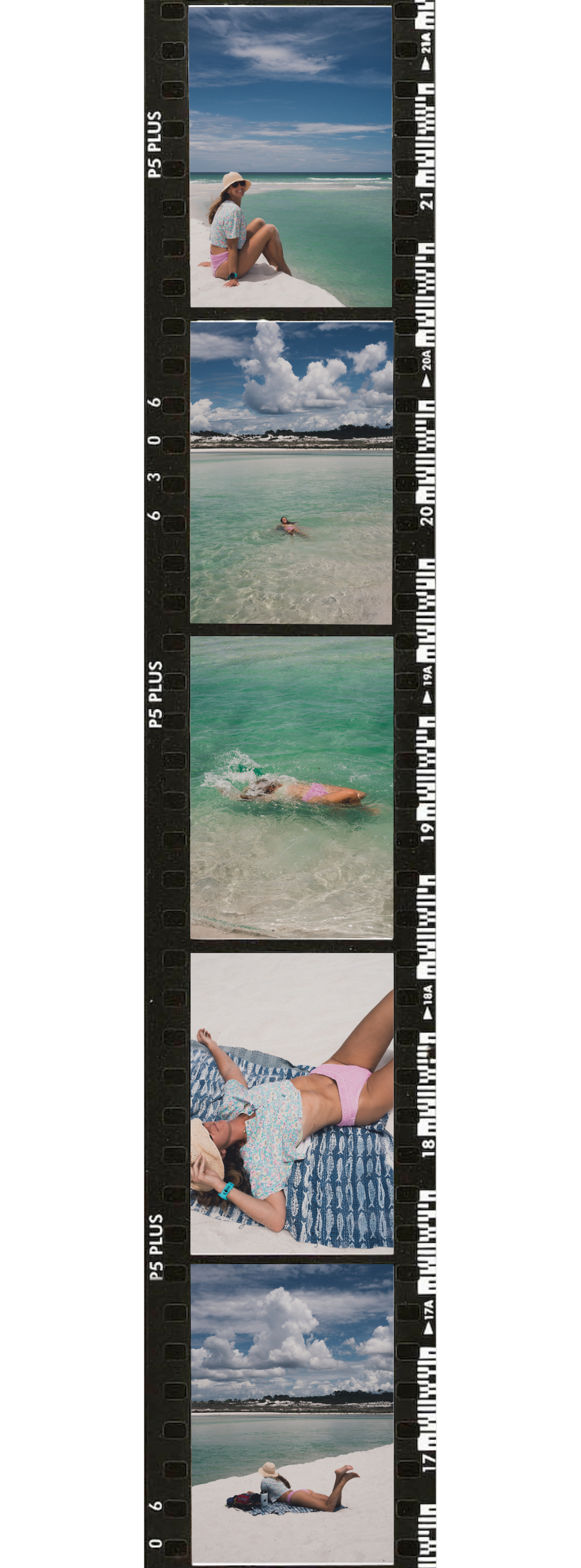
A lot of my self-portrait work started out of practicality. I had ideas I wanted to try and no one to shoot. I’d be out in nature alone, see something beautiful, and feel like it needed a person in the frame. It wasn’t some big artistic decision—I just didn’t have a subject, so I used myself.
And I had to learn everything that way. How to use a camera, how to set it up, how to run in and out of the frame. How to edit. Most of it was trial and error—and a lot of error. I can’t tell you how many shots didn’t work, how many times I missed something completely. Perfect light gone, slightly out of focus, bad timing. All of it. I’ve done it on both digital and film.
At the time, it felt like practice. And I treated it that way for a long time. Even when I was building a portfolio, I remember questioning whether those images really counted—like, can I include these if I’m in them? Do serious photographers photograph themselves? I felt self-conscious about it.
But looking back, that’s where most of my work actually came from.
It was just me trying things, over and over again, without anyone watching. And that kind of space is hard to get when you’re shooting other people. There’s always some level of pressure—time, expectations, performance. When it’s just you, that disappears.
You can experiment. You can get it wrong. You can follow an idea without worrying if it’s worth it.
That’s where the creative play came in.
And I don’t think I realized at the time how important that was. Shooting myself gave me a way to play—freely, without pressure—and that’s what actually made me better. That’s how I developed my eye. I don’t think I would’ve gotten there the same way if I had always been shooting other people.
It also does something else for me that’s harder to explain. It’s a quieter kind of process. It feels good in a different way. Like it fills something up, even when nothing “comes” from it.
At this point, I don’t really separate “play” from “real work.” The photographs I’m most proud of almost always come out of that state—whether I’m in the frame or not.
There are still things I can’t do alone—ideas that need another person. But I don’t see self-portraiture as a fallback anymore. It’s just a different way of working. And honestly, it’s one of the easiest ways to access that kind of creative play.
I think part of why it can feel less legitimate now is because the idea of a “self-portrait” has been flattened into selfies. They’re not the same thing. One is quick, reactive, and made to be seen. The other can be slower, more intentional, and often never shared.
Self-portraiture has always been part of serious work. Some of the most well-known work is self-portraiture. But somewhere along the way, it started to feel like something lesser.
I felt that too. I don’t feel that way anymore.